Building Above and Beyond at Phillips 66

Updated: Jan 23
Outfitted in personal protective equipment and fire-resistant clothing, Journeyman Piledriver Frank Pineda stands just 20 ft from Manson's DB SCANDIA, laser focused as he guides Operator Josh Mitton in positioning a section of the access frame onto the causeway for the Phillips 66 Causeway Replacement project in Ferndale, WA.

This high-profile project for Phillips 66—a leading oil and gas company—tasked Manson with removing a deteriorating 1,800-ft timber causeway and constructing a new concrete structure founded on steel piles. Designed to enhance the transportation of equipment and materials to oil tankers and fuel ships, the new causeway promises greater efficiency and reliability for Phillips 66’s operations.
The engineering team faced numerous challenges throughout the project, including unpredictable weather, working without impacting Phillips 66’s routine operations, and site-specific difficulties requiring the development of innovative work sequences. One major hurdle was removing the old causeway while simultaneously building the new one mere inches away from it.
“This approach was a first for everyone on the team,” explains current Project Manager Jeff Garcia. “Nobody had ever taken down an old structure while constructing a new one just inches away. We had to use this method because Phillips needed their loading wharf at the end of the causeway to remain fully operational.”
From the outset, Manson prioritized building a strong partnership with the Phillips 66 Project Team to ensure the project met expectations. Weekly meetings kept both teams aligned on leadership, work features, equipment needs, scheduling, subcontractor responsibilities, and other critical project activities.
“The Project Management team at Phillips has been extremely responsive and helpful, always willing to work through concerns,” notes Project Engineer Kurt Dever. “Effective communication has allowed us to operate within the facility’s policies and procedures, helping us avoid major problems.”
Starting the New Causeway
The project launched in November 2019, with Kurt and two other team members deploying the derrick barge DB24 and flat barge M70 to initiate piledriving for the new causeway structure. In an unconventional move for marine demolition and construction, the team planned to drive piles before demolishing the existing structure—a process that required precise coordination due to the limited workspace.

As the seasons changed and inclement weather arrived, 40 piles were driven before the team demobilized, planning to return at a later date. In late 2020, Kurt, then-Project Manager Drew Paup, Field Engineer Ian Salmon, and Superintendent Mike Ramos returned to Phillips 66, bringing in the SOUTHMAN and the M70 to drive another 40 piles and start additional features of work.
With a total of 80 new piles installed, subcontractor Crux Diving dove below the surface to install anodes to protect the new steel piles from corrosion.
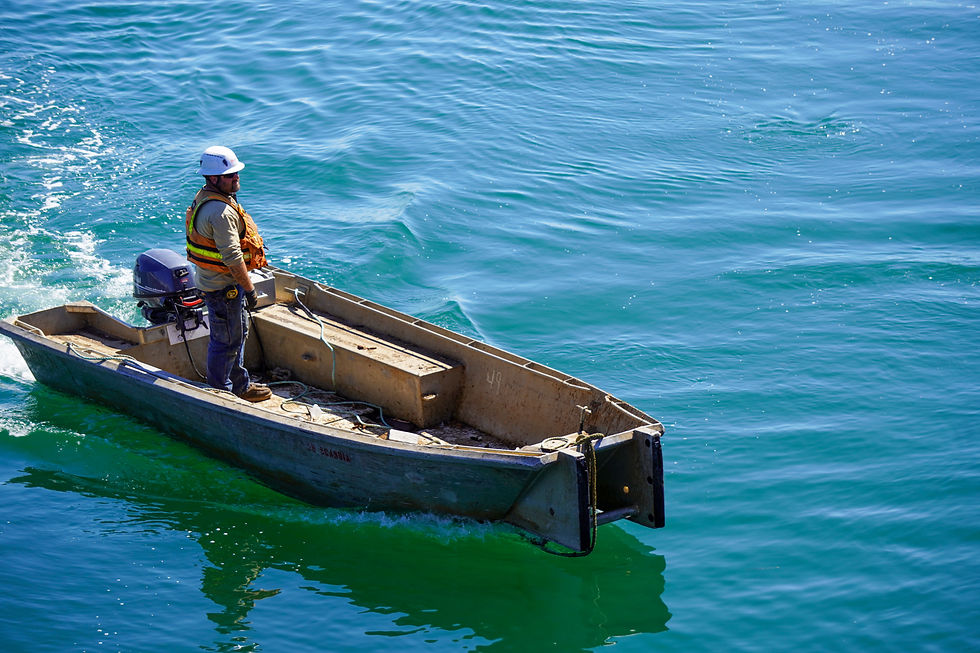
After pile installation, the crew used chainsaws to remove sections of the old causeway. Fallen debris was towed by skiff to the M70 for recycling. Using the SOUTHMAN, the team positioned the access frame onto the structure so piledrivers could safely cut the piles to the proper height with specialized tools. Once elevations were verified, friction collars were installed, and precast pile caps were set using the SOUTHMAN. The team then pumped water from the piles, installed rebar cages, and poured concrete to secure both piles and caps. The original timber causeway had relied on more than 700 timber piles arranged in multiple rows per bent; the new design uses fewer but much stronger steel piles, delivering enhanced structural integrity.

The team continued work at Phillips until early 2021, when they received notice of planned maintenance at the refinery site and supporting facilities. Kurt and the project team demobilized, taking on other assignments.
During this period away, Manson maintained communication with Phillips 66 and remained committed to their partnership, aiming to complete the project in the future. After site and project management changes at Phillips, Manson received the call to return in 2024.
Returning to Finish the Job
Three years after the initial phase, Kurt returned to Phillips 66 with Jeff, and Superintendent Drew Edwards to resume construction of the new causeway. The return also brought new faces, including Field Engineers Andrew Harper and Erin Arviso, as well as several original project members working aboard the SOUTHMAN and SCANDIA.
To leverage the expertise of Manson’s engineers and tradesmen, Jeff, Kurt, and Drew assembled a skilled team consisting of General Foreman Graydon Bennett, Carpenter Foreman Peder Mork, Piledriver Foreman Jason Safronik, and Journeyman Piledriver Frank Pineda, to provide essential support for the project’s success.
To accelerate progress and capitalize on the skills of the talented project team, Jeff, Kurt, and Drew organized two 12-hour shifts (day and evening). Day crews focused on causeway demolition, piledriving, installing access frames, precast pile caps, and precast channel beams while evening crews used the SOUTHMAN to remove the old timber cross-bracing and piles. Planning for this work was greatly enhanced with computer modeling. Field Engineer Erin Arviso essentially “pre-built” the work entirely in the model to perform clash detection and allow the field teams to simulate key features of the work including safe access, sequencing, traffic flow, and logistics.
During this phase, the causeway deck was built in halves to maintain uninterrupted traffic. As each half was completed, the corresponding section of the original causeway was demolished, channel beams installed, and concrete closures poured. Once the deck slab was poured and cured, vehicle traffic shifted to the newly finished side, and the process was repeated for the opposite half. To ensure smooth operations, the team actively managed vehicle and personnel movement to and from the dock, using temporary bridges lifted by the SCANDIA for demolition and construction activities—first removing either the north or south half, then redirecting traffic as needed.
During evening operations, the SOUTHMAN crew removed existing timber piles to dismantle the old foundation. Debris was appropriately collected and loaded onto the M50 for disposal.
With the team firmly in place and momentum building, the project is on track to deliver a new 1,800-ft causeway to Phillips 66 in 2026, fulfilling Manson’s commitment to build a structure that will support client operations for decades to come.
“One of the greatest advantages of working with Manson is the caliber of our engineers and tradesmen,” Jeff says. “Team members like Kurt, Drew, Graydon, Jason, and Frank consistently excel in demanding conditions—even after a multi-year pause. Together, they’ve perfected their methods down to a science, enabling us to continue this project successfully.”


Comments